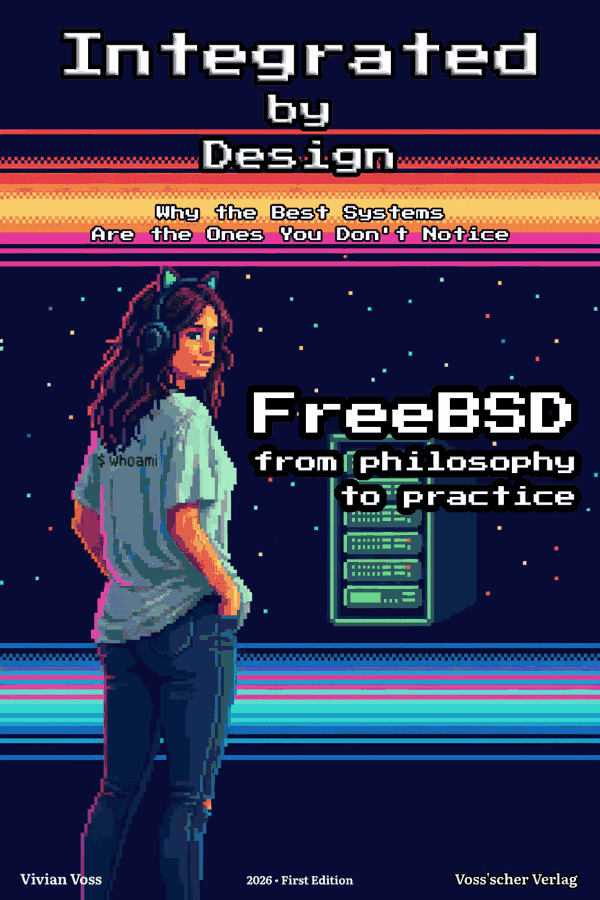
Vivian Voss
System Architect & Software Developer.
37 years in the game. 26 professionally.
Building minimal tools that earn every byte.
Inspired by the demoscene. Guided by Unix philosophy.
Using AI to engineer, educate and validate, not to replicate the bloat faster.
What I Do
I design systems where reduction is the method, not the compromise.
Small binaries. Semantic markup. Honest interfaces.
Every abstraction must justify its weight.
Currently Senior Developer at a German DIY wholesale giant,
working with React, TypeScript, and Spryker. Privately building
small tools for testing ideas,
ultralight and rooted in demoscene constraints.
Focus
System architecture, performance engineering, and the frontend
that sits on top of both. Full-stack, if you must; I prefer
to call it taking responsibility for the whole path.
The common thread is root cause over symptom: I would rather
remove the reason a system is slow than buy hardware to
outrun it.
I keep a German-language record of how that diagnosis is done, at
advisor.vivianvoss.net:
what gets measured, what a written finding contains, and where the
system boundary is drawn. It documents a way of working rather than
an offer; I take no mandates.
Three Series, One Argument
The writing here runs in three parallel series:
Lean Software, on building less and getting more;
Unix Universe, on the operating systems that
outlived their critics; and IT Philosophy, on why
we keep making the same expensive mistakes. Different
angles, same argument: complexity is a cost, not an
achievement.
The Hardware Trail
1989 ■ Amiga 500
1992 ■ Atari Mega STE
1994 ■ 486 DX2/66
1996 ■ Unix/Linux
1996 ■ Matrox Millennium
1998 ■ 3dfx Voodoo2
2000 ■ First paycheck for code
2000 ■ IBM ThinkPad
2008 ■ MacBook Pro
Rust■
C■
Java■
Python■
Swift■
HTML■
CSS■
JavaScript■
TypeScript■
Tcl/Tk■
PHP■
Lua■
sh■
FreeBSD■
Linux■
BeOS■
QNX■
AS/400■
BASIC■
Pascal■
Rust■
C■
Java■
Python■
Swift■
HTML■
CSS■
JavaScript■
TypeScript■
Tcl/Tk■
PHP■
Lua■
sh■
FreeBSD■
Linux■
BeOS■
QNX■
AS/400■
BASIC■
Pascal■
Series
vivian@vivianvoss:~ $ tree -L 2 /series26 series · 296 dispatches
Latest Writing
21 Oct
lean software
freebsd
debian
A Debian 13 cloud image is 322 packages from 216 source packages and 94 upstream projects, carried by 129 maintainers; a bug that belongs upstream is marked forwarded, and it waits there. FreeBSD's base comes from one tree and one team, 403 committers with a Core Team of nine, and a bug between library and kernel was one commit of seven files with a test. Two seams with dates, two commits with their file lists, and Conway taken as a compliment.
20 Oct
like for like
freebsd
ubuntu
Three lines of ufw load 105 rules through three tools you were promised never to see; ufw status shows your three. Four lines of pf.conf on FreeBSD become six rules, and pfctl -sr prints the same six back.
19 Oct
unix universe
freebsd
ubuntu
Ubuntu 26.10 finished swapping ls, cp, mv and rm for a rewrite in Rust; its own audit found 44 CVEs, and rm segfaulted on a deep directory in September. On FreeBSD the same four files have lived in one tree with the kernel since 1994, and rm cleared 32,801 nested directories in a jail this morning.
17 Oct
bytes of art
demoscene
4k intro
A 1991 Amiga classic retold in 4,029 bytes: a fractal formula, a ray per pixel, music from the same file, and first of nine at Revision 2012. The readme in the archive is bigger than the intro.
16 Oct
technical beauty scope
freebsd
carp
Two FreeBSD machines share one IP address with two lines of configuration and no daemon, and the same interface speaks VRRPv3. pfsync carries the firewall's state across and holds a rebooted machine back until the table has arrived.
All articles →
This Page Right Now
No framework. No build step. Measured live in your browser. Pure CAST Daemon.
---
TTFB
---
FCP
---
LCP
0 ms
TBT
---
CLS
---
Transfer Size
The numbers above are measured live in your browser: your connection,
your device, no averages. Below is what Google thinks of the result.
Lighthouse
audits four dimensions: raw speed, semantic accessibility,
security and API hygiene, and search engine visibility.
Four perfect scores from a self-made Rust binary web server with zero dependencies.
Google Lighthouse. Measured on vivianvoss.net,
this site, served by CASTD — an extremely fast self-made
and full scale web and content server written in pure Rust with zero dependencies.